
Introduction
SEC Rules 605 and 606, established under Regulation NMS, form the backbone of transparency in the U.S. equity markets. Collectively, they provide regulators and investors with insight into execution quality and order routing behaviour. Among them, Rule 606(a) carries particular relevance for senior management, as it directly exposes a firm’s routing strategy, conflicts of interest, and venue relationships to public scrutiny.
From the reporting entity perspective, these rules are not compliance checklists—they are conduct risk indicators. They test whether a firm’s actual trading behaviour aligns with its stated best-execution obligations and governance framework.
- Rule 605 addresses how well customer orders are executed
- Rule 606(a) addresses where customer orders are routed and the economic incentives behind those decisions
- Rule 606(b) provides customer-specific routing transparency upon request
Why Rule 606(a) Matters to Senior Management
Regulators increasingly view order routing disclosures under Rule 606(a) as a window into a firm’s market conduct culture. Weaknesses or inconsistencies in these disclosures can lead to:
- Heightened regulatory scrutiny and enforcement risk
- Reputational damage and loss of investor confidence
- Challenges to best-execution claims
- Exposure of unmanaged conflicts, including payment for order flow (PFOF) or affiliate routing arrangements
Crucially, Rule 606(a) is function-based, not size-based. Any broker-dealer that routes customer orders—regardless of scale or sophistication—is within scope.
Obligated Firms – Rule 606(a) (Order Routing Transparency)
Who is in scope?
Rule 606(a) applies to broker-dealers that:
Accept customer equity or options orders, and
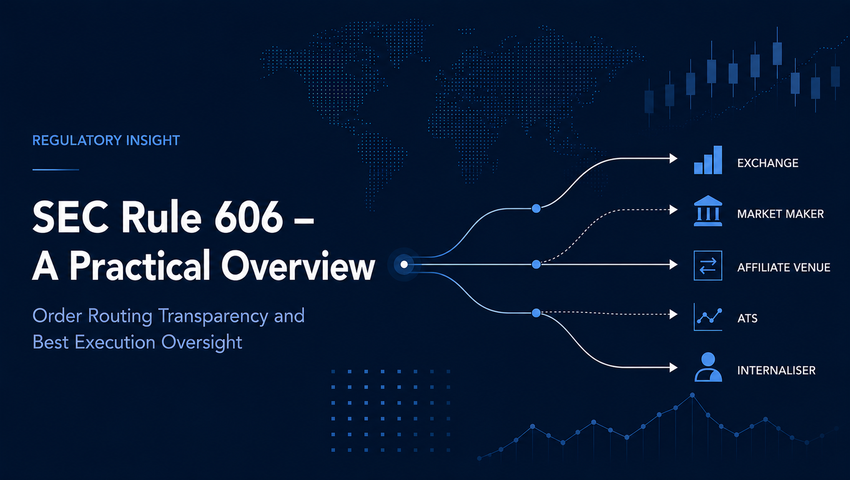
Route those orders to exchanges, market makers, ATSs, or affiliates
Execution is not required. The routing decision itself creates the obligation.
Senior risk focus:
Governance over routing logic, venue selection criteria, and affiliate relationships is central to Rule 606(a) compliance.
Key exemptions
- Proprietary-only trading activity
- Firms that do not accept customer orders
- Firms operating exclusively in FX, commodities, or fixed income products
Organizational nuance
- Introducing brokers are in scope if they influence routing decisions
- Clearing-only brokers may be out of scope where routing discretion does not exist
Reporting Format – Rule 606(a)
Rule 606(a) requires public, quarterly disclosures that provide market-wide transparency into a firm’s routing behaviour, including:
- Primary execution venues
- Distribution of order types (market, marketable limit, non-marketable limit)
- Payment for order flow arrangements
- Material relationships with execution venues, including affiliates
These disclosures are a direct reflection of a firm’s routing governance and conflict management framework.
Reporting Timeline and Oversight
- Rule 606(a): Quarterly publication, within one month of quarter-end
- Rule 605: Monthly publication, within one month of month-end
- Rule 606(b): On-demand, typically within 7–30 days
From a regulatory standpoint, late or inconsistent disclosures are often interpreted as control weaknesses, not operational delays.
Relationship to Rules 605 and 606(b)
While Rule 606(a) focuses on routing decisions and incentives, it should be read alongside:
- Rule 605, which measures execution outcomes at market centres; and
- Rule 606(b), which requires customer-specific routing disclosures upon request
Together, the three form a closed loop between decision-making, outcomes, and client transparency.
Takeaway
Rule 606(a) should be viewed as a front-line conduct risk control, not a reporting exercise.
- Routing functions require strong Rule 606(a) governance
- Execution functions require Rule 605 oversight
- Client transparency obligations are reinforced through Rule 606(b)
For CROs and senior leadership, effective compliance depends on clear accountability, documented routing decisions, data integrity, and alignment between disclosures and real trading behaviour. When managed proactively, Rule 606(a) strengthens both SEC regulatory posture and market credibility.