
ISO 20022 XML
UTI, UPI & CDE
Trade & Lifecycle Events
Valuation, Margin & Collateral
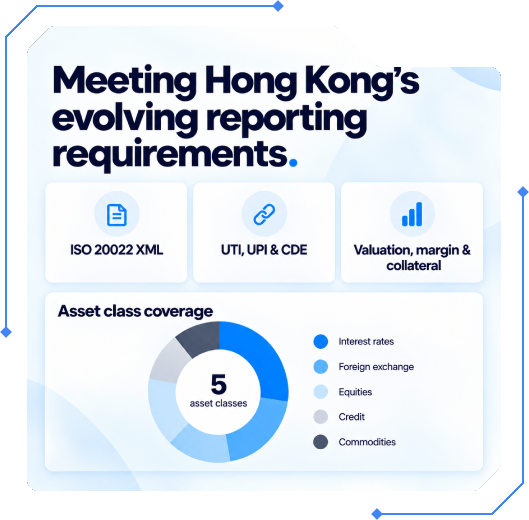
Meeting Hong Kong’s evolving reporting requirements.
Hong Kong’s OTC derivatives reporting regime requires specified transactions to be reported to the Hong Kong Trade Repository (HKTR), operated by the Hong Kong Monetary Authority. The framework covers interest rates, foreign exchange, equities, credit and commodities.
Reporting now incorporates ISO 20022 XML, Unique Transaction Identifiers, Unique Product Identifiers and Critical Data Elements, together with valuation, margin and collateral information. This increases the amount of data, control and reporting logic firms need to manage across the reporting lifecycle.
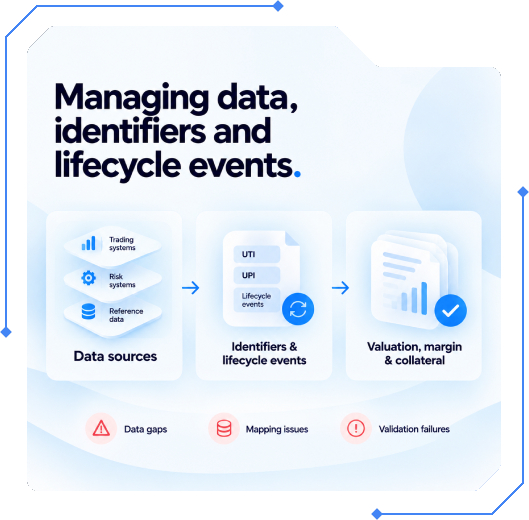
Managing data, identifiers and lifecycle events.
HKTR reporting depends on accurate data being sourced from multiple trading, risk, reference data and operational systems. Firms need to apply the correct reporting logic, manage identifiers, maintain lifecycle-event reporting and meet ongoing valuation and collateral obligations.
Data gaps, inconsistent mappings, validation failures and downstream exceptions can create reporting risk even where the submission process itself is functioning. Reporting teams therefore need visibility across both pre-submission controls and the quality of what has actually been reported.
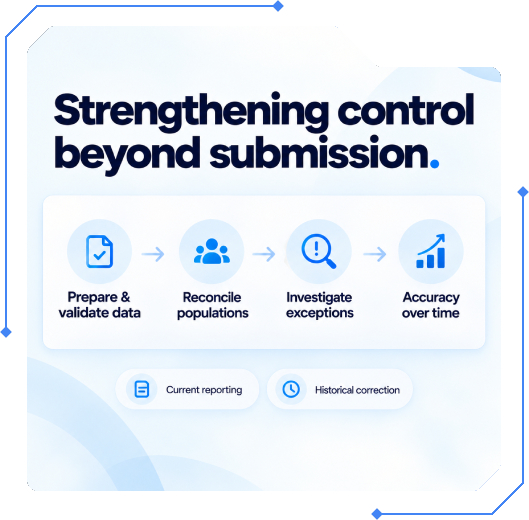
Strengthening control beyond submission.
Effective HKTR reporting requires more than producing a technically valid message. Firms need to prepare and validate reporting data, identify inconsistencies, reconcile expected and reported populations, investigate exceptions and confirm that reporting remains accurate and complete over time.
Reg-X supports this broader control model across current reporting and historical correction, helping firms move from fragmented reporting checks to a more structured approach to regulatory reporting assurance.
From HKTR requirements to reporting controls.
A control framework aligned to the specific data, identifiers and ongoing reporting obligations within HKTR.
- ISO 20022 XML reporting
- UTI and UPI reporting
- Critical Data Elements
- Trade and lifecycle-event reporting
- Valuation information
- Margin and collateral data
- Builds HKTR ISO 20022 reporting messages
- Applies and validates UTI & UPI logic
- Maps and validates Critical Data Elements
- Controls trade and lifecycle-event reporting
- Checks valuation data for gaps and inconsistencies
- Validates margin and collateral reporting data
Support the full HKTR reporting lifecycle.
Support accurate, complete and controlled reporting across the HKTR reporting lifecycle.
01 Prepare & Report
Standardise, enrich and transform source data into the required HKTR reporting structure.
02 Validate & Reconcile
Apply regulatory checks and identify breaks between expected, submitted and reported information.
03 Assure Data Quality
Assess reported data for accuracy, completeness, recurring exceptions and control weaknesses.
04 Investigate & Correct
Trace issues to their source, prioritise remediation and correct historical reporting where required.
Why Reg-X
01 HKTR Reporting Expertise
Practical support across Hong Kong OTC derivatives reporting requirements, controls and implementation.
02 ISO 20022 Readiness
Support for HKTR ISO 20022 data mapping, transformation, validation and ongoing reporting changes.
03 UTI, UPI & CDE Controls
Structured controls for identifiers and Critical Data Elements across HKTR reporting workflows.
04 Lifecycle & Valuation Assurance
Controls across trade events, lifecycle reporting, valuations, margin and collateral data.
05 Accuracy & Completeness
Go beyond successful submission to identify inaccurate data, missing reporting and recurring exceptions.
06 Agentic AI Framework
Governed AI support for regulatory analysis and exception investigation while retaining deterministic control over reporting logic.
Frequently Asked Questions (FAQ)
The Hong Kong Trade Repository (HKTR) is operated by the Hong Kong Monetary Authority (HKMA). It provides the electronic infrastructure for collecting, maintaining and storing OTC derivatives transaction data submitted under Hong Kong’s mandatory reporting regime. HKTR supports regulatory reporting across trade information, lifecycle events, valuations, margin and collateral data.
Hong Kong’s mandatory OTC derivatives reporting regime covers five key asset classes: interest rates, foreign exchange, equities, credit and commodities. Mandatory reporting was expanded to all five asset classes in July 2017, with subsequent enhancements introducing more granular and standardised reporting requirements.
Reporting obligations can apply to entities including Authorised Institutions, Approved Money Brokers, Licensed Corporations and recognised clearing houses, subject to the applicable scope, thresholds, exemptions and reliefs under Hong Kong’s OTC derivatives reporting rules. Firms should assess their obligations based on their entity type and OTC derivatives activity.
From 29 September 2025, Hong Kong adopted the ISO 20022 XML message standard for OTC derivatives reporting and introduced mandatory use of Unique Transaction Identifiers (UTIs), Unique Product Identifiers (UPIs) and Critical Data Elements (CDEs). The enhanced framework also includes detailed valuation, margin and collateral reporting requirements.
HKTR uses ISO 20022 XML for submitting OTC derivatives reporting data. Trade information, including transaction, valuation, margin and collateral information, is submitted using standardised XML messages in accordance with HKTR’s Administration and Interface Development Guide and Supplementary Reporting Instructions.
A UTI uniquely identifies an OTC derivatives transaction, while a UPI identifies the underlying derivative product. Critical Data Elements (CDEs) provide harmonised transaction information intended to improve consistency and comparability of derivatives data. Hong Kong incorporated these international data standards into its enhanced OTC derivatives reporting framework.
HKTR reporting extends beyond the creation of a new trade. Reportable information can include subsequent lifecycle events affecting key economic terms, as well as valuation, margin and collateral information. Lifecycle events may include changes such as amendments, partial terminations and full terminations.
In general, a reportable transaction or subsequent event must be reported within two business days, commonly referred to as T+2. Daily valuation information is also generally required on a T+2 basis. Reporting entities should follow the applicable HKTR instructions for margin and collateral reporting and any specific transitional arrangements.
The November 2026 HKTR release introduces enhanced validation rules, mandatory system-level UPI reporting and additional ISO reporting functionality. From 21 November 2026, pre-ISO valuation submissions will no longer be accepted, pre-ISO system reports will cease, and HKTR will introduce ISO enquiry functionality and a Missing Valuation Data Report.
Reg-X supports firms across the HKTR reporting lifecycle, from data preparation, regulatory mapping and ISO 20022 reporting through validation, reconciliation, exception investigation, accuracy and completeness assurance, and historical correction. This helps firms move beyond technical submission toward a more controlled approach to ongoing HKTR reporting quality.