
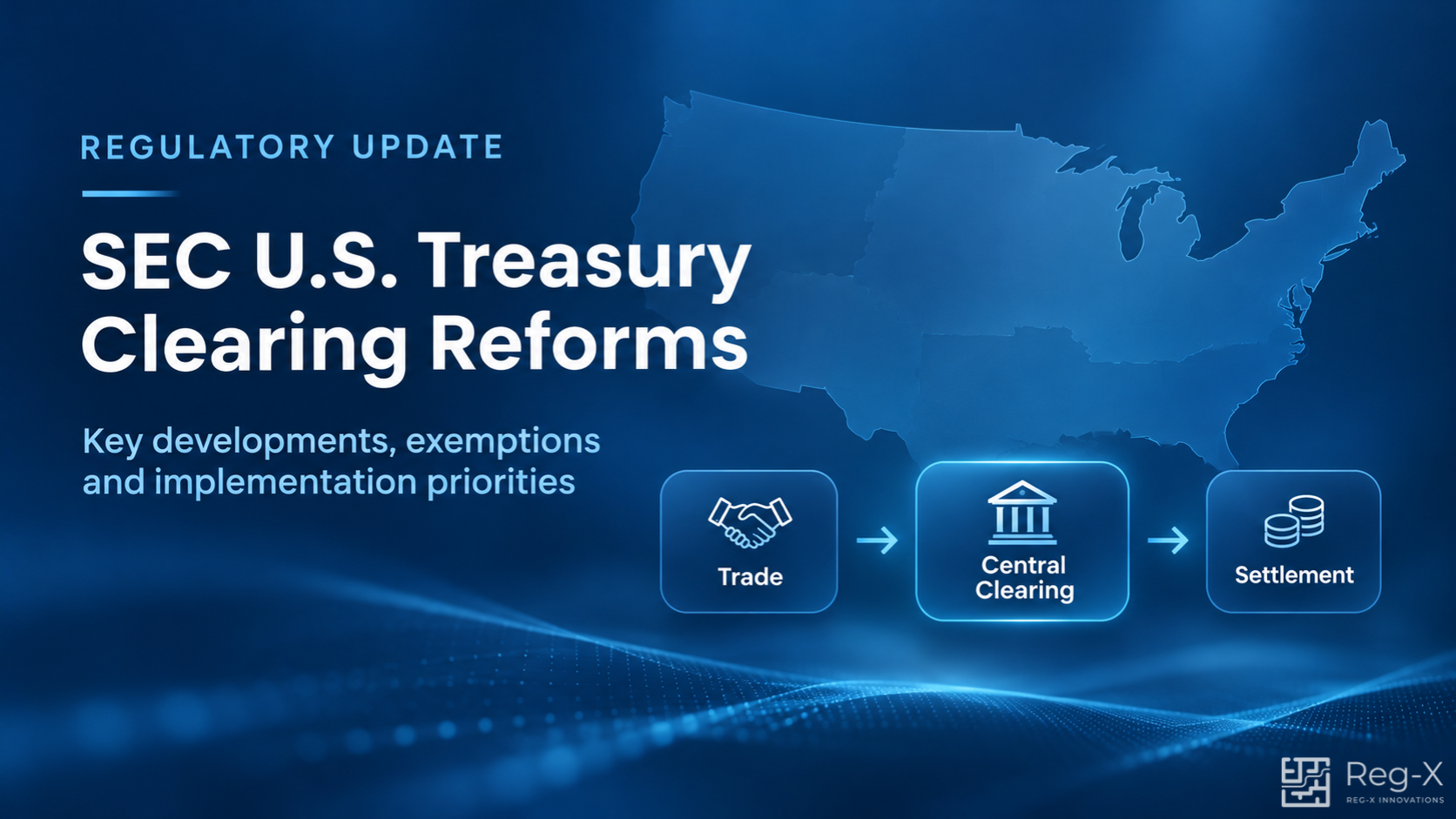
Mandatory central clearing of U.S. Treasury securities – regulatory developments, implementation deadlines and implications for securities finance.
1. Executive summary
The U.S. Securities and Exchange Commission (SEC) is progressing with one of the most significant structural reforms to the U.S. Treasury market in recent years: the introduction of mandatory central clearing for eligible U.S. Treasury cash and repurchase agreement (Repo) transactions.
Originally adopted in December 2023, the reforms are intended to reduce systemic counterparty risk, improve market resilience, increase transparency and strengthen the management of exposures across the Treasury market.
Following industry concerns about implementation readiness, the SEC extended the original compliance deadlines by 12 months. The revised deadlines are:
- 31 December 2026: Mandatory central clearing for eligible U.S. Treasury cash transactions.
- 30 June 2027: Mandatory central clearing for eligible U.S. Treasury Repo transactions.
The most recent significant development is the SEC’s announcement of 30 October 2026, granting targeted exemptions for certain inter-affiliate and non-U.S. Repo transactions.
This is particularly important for international banks, global securities-finance providers and firms operating across multiple legal entities. It provides some relief from the original requirements while retaining the broader objective of moving Treasury market activity towards central clearing.
The reforms should not be viewed simply as a regulatory reporting or clearing-system change. They represent a fundamental alteration to Treasury market operating models, counterparty relationships, collateral management, margin funding, trade processing and the economics of Repo transactions.
The cash-market deadline is now imminent, and firms should be treating implementation as a business-critical delivery programme rather than a future regulatory consideration.
Sources: SEC Treasury Clearing Implementation and SEC announcement of 30 October 2026.
2. What is the SEC introducing?
The SEC’s December 2023 final rule, formally titled “Standards for Covered Clearing Agencies for U.S. Treasury Securities and Application of the Broker-Dealer Customer Protection Rule with Respect to U.S. Treasury Securities”, introduces requirements designed to increase the proportion of eligible Treasury transactions processed through a central counterparty (CCP).
The principal regulatory change is that covered clearing agencies must maintain policies and procedures requiring their direct participants to centrally clear eligible secondary-market transactions in U.S. Treasury securities.
In practical terms, the CCP interposes itself between the buyer and seller, becoming the buyer to every seller and the seller to every buyer.
This changes the traditional bilateral counterparty relationship into a centrally cleared arrangement.
The reform covers two principal transaction categories:
| Transaction category | Regulatory requirement |
|---|---|
| Treasury cash | Eligible outright purchases and sales of U.S. Treasury securities |
| Treasury Repo | Eligible repurchase and reverse repurchase transactions collateralised by U.S. Treasury securities |
Importantly, this is not a requirement to clear every Treasury transaction without exception. The rules contain defined exclusions, exemptions and conditions.
Sources: SEC Final Rule Release 34-99149 and Arnold & Porter regulatory materials.
3. Implementation timetable
Regulatory milestones
- 13 December 2023 – Final rule adopted: SEC formally adopts the Treasury Clearing reforms.
- 25 February 2025 – Deadline extension: Original compliance deadlines extended by 12 months.
- 30 September 2025 – Clearing agency requirements: Extended deadline for clearing agencies to implement and enforce relevant practices, policies and procedures.
- 31 December 2026 – Cash-market clearing (Next major deadline): Mandatory clearing of eligible U.S. Treasury cash transactions.
- 30 June 2027 – Repo-market clearing: Mandatory clearing of eligible U.S. Treasury Repo transactions.
Source: SEC and regulatory implementation materials (Arnold & Porter).
The distinction between cash and Repo deadlines is important. Although firms may be prioritising cash-market readiness, the Repo requirement is arguably more operationally complex for securities-finance businesses because of its implications for collateral movements, financing arrangements, margin and indirect clearing access.
4. The latest regulatory development – October 2026 exemptions
New SEC announcement – 30 October 2026
The SEC has issued exemptive relief from the Treasury Clearing requirements for certain inter-affiliate and non-U.S. Repo transactions.
The announcement follows industry consultation and representations from organisations including the Institute of International Bankers (IIB) and the Securities Industry and Financial Markets Association (SIFMA).
The relief addresses two principal areas:
- Certain non-U.S. Repo transactions: Certain Repo transactions involving non-U.S. counterparties are excluded from the definition of eligible secondary-market transactions, subject to specified limits and conditions. This is particularly relevant to international banking groups and firms conducting Treasury financing business through overseas entities.
- Certain inter-affiliate Repo transactions: Certain Repo transactions between a direct participant of a U.S. Treasury clearing agency and an affiliated entity are also excluded, provided the affiliate:
- Is not an investment company as defined under Section 3 of the Investment Company Act of 1940.
- Otherwise meets the relevant definition of an affiliated counterparty under SEC Rule 17ad-22(a).
Source: U.S. Securities and Exchange Commission (sec.gov).
Why this matters
The original requirements created potential complications for global institutions operating through multiple legal entities and jurisdictions.
For example, a global banking group might conduct Treasury financing through:
- A U.S. broker-dealer.
- A UK or European banking entity.
- An offshore financing subsidiary.
- An affiliated investment or fund vehicle.
Without appropriate exclusions, certain intra-group and cross-border financing arrangements could have been brought into the mandatory clearing framework, potentially increasing operational complexity and clearing costs.
The October announcement provides targeted relief, but it should not be interpreted as a blanket exemption for international institutions or all inter-affiliate Repo activity.
Firms must establish transaction-level eligibility against the detailed exemption conditions before excluding activity from their clearing populations.
5. Implications for securities-finance operations
For securities-finance businesses, the most significant implications arise from the transition away from traditional bilateral Treasury Repo processing towards centrally cleared arrangements.
Six principal areas require operational and commercial focus:
| Area | Operational and commercial implications |
|---|---|
| Counterparty management | New clearing relationships, membership arrangements, sponsored access and indirect clearing models. |
| Collateral management | Revised collateral eligibility, haircuts, margin requirements, substitution processes and collateral mobilisation. |
| Margin and liquidity | Increased importance of initial margin, variation margin, intraday liquidity and funding arrangements. |
| Trade processing | Changes to trade submission, matching, novation, settlement and exception management. |
| Legal documentation | Amendments to clearing agreements, customer documentation, sponsorship arrangements and counterparty terms. |
| Risk management | Greater CCP exposure management, default management, concentration monitoring and liquidity stress testing. |
Particular considerations for Repo
There are several areas that deserve specific attention from Repo operations and product management:
- Bilateral versus centrally cleared Repo: Firms will need to distinguish eligible transactions requiring clearing from transactions that remain outside the mandate. This requires accurate identification of transaction type, counterparties, legal entities, collateral and relevant exemptions.
- Sponsored clearing: The sponsored model is particularly important for firms that do not intend to become direct clearing members. It allows eligible clients to access central clearing through a sponsoring intermediary, subject to the relevant CCP rules and arrangements. This creates additional considerations around client onboarding, credit assessment, margin collection, default management and operational responsibilities.
- Collateral and margin management: Central clearing introduces a different collateral and margin dynamic. Firms will need to understand the implications of:
- Initial margin requirements.
- Variation margin movements.
- Eligible collateral schedules.
- Haircut methodologies.
- Intraday margin calls.
- Margin segregation.
- Collateral optimisation and funding.
- Trade lifecycle management: The introduction of clearing requirements will affect the entire transaction lifecycle, from execution and trade submission through to novation, settlement, collateral movements and eventual maturity. Failed trades and transactions that cannot be novated also require particular attention. These are not simply front-office considerations; they have significant implications for middle-office, collateral management, settlements and operational controls.
6. Clearing infrastructure and market participants
The SEC’s implementation programme has also developed beyond the original FICC-centric model. The principal clearing infrastructure providers now include:
| Clearing Agency | Role and Infrastructure Overview | Reference |
|---|---|---|
| Fixed Income Clearing Corporation (FICC) | The established U.S. Treasury clearing infrastructure within DTCC. Its Government Securities Division (GSD) is central to the market’s clearing arrangements, including sponsored clearing. | DTCC – FICC Government Securities Division |
| CME Securities Clearing | An additional SEC-approved clearing agency providing an alternative route for Treasury clearing, with cross-margining arrangements involving FICC. | CME Group |
| ICE Clear Credit | Another SEC-approved clearing agency seeking to provide Treasury securities clearing services, adding further choice to the clearing infrastructure landscape. | ICE Clear Credit |
The expansion of clearing infrastructure is significant because participants will need to assess not just regulatory compliance, but also the commercial and operational merits of different clearing arrangements.
These include margin methodologies, collateral eligibility, clearing fees, netting opportunities, connectivity, client access and default management.
One particularly important development is the approved FICC/CME customer-level cross-margining arrangement, which could provide capital and collateral efficiencies where eligible positions can be offset.
Source: SEC Treasury Clearing Implementation.
7. Other regulatory and implementation developments
The October exemptions are not the only developments firms should be monitoring. The SEC’s November 2026 implementation webpage identifies several additional areas of regulatory progress:
| Development | Significance |
|---|---|
| Net omnibus margin relief | SEC has issued exemptive relief under the broker-dealer customer protection rules for margin calculated and delivered on a net rather than gross basis. |
| Captive clearing subsidiaries | Conditional relief allows certain private funds to access clearing through qualifying captive clearing subsidiaries. |
| Clearing agency outages | SEC staff guidance recognises that bilateral trading may remain available in certain circumstances when a clearing agency cannot accept transactions. |
| Failed trades | Treatment of transactions that fail to novate remains an implementation consideration. |
| FICC sponsored clearing | Expanded services include done-away trade submission and collateral-in-lieu arrangements. |
| FICC/CME cross-margining | Customer-level cross-margining has received SEC approval, potentially improving capital and collateral efficiency. |
Sources: SEC implementation webpage and Commissioner Uyeda’s August 2026 update.
Two developments deserve particular attention:
Net omnibus margin relief: This is relevant to broker-dealers managing customer margin arrangements. It addresses the treatment of margin held on a net omnibus basis under the customer protection requirements of Rule 15c3-3. The relief could help reduce operational friction associated with the movement and segregation of customer margin.
Done-away clearing arrangements: SIFMA published a standardised U.S. Treasury Done-Away Securities Clearing Agreement on 30 July 2026. This is important because it seeks to simplify documentation and onboarding where the executing dealer and clearing intermediary are different entities. For securities-finance providers, this could help facilitate indirect access to clearing without requiring every participant to become a direct clearing member.
8. Recommended actions for financial institutions
Firms should organise their implementation programmes around the following eight priority workstreams:
| Priority | Recommended action |
|---|---|
| 1. Transaction scoping | Identify all U.S. Treasury cash and Repo activity, distinguishing eligible, excluded and exempt transactions. |
| 2. Counterparty analysis | Map direct participants, indirect participants, affiliates and non-U.S. counterparties. |
| 3. Clearing strategy | Determine whether to participate directly, use sponsored clearing or access alternative clearing arrangements. |
| 4. Legal documentation | Review clearing agreements, client documentation, sponsorship terms and inter-affiliate arrangements. |
| 5. Collateral and margin | Assess margin requirements, haircuts, collateral eligibility, funding and liquidity impacts. |
| 6. Technology and data | Implement transaction identification, eligibility rules, clearing submission, reconciliation and exception management. |
| 7. Operational readiness | Test execution-to-clearing workflows, settlement, novation, margin calls, fails and contingency arrangements. |
| 8. Governance | Establish accountable ownership, implementation milestones, testing evidence and ongoing regulatory oversight. |
Establish a Treasury Clearing eligibility framework
Particular emphasis should be placed on developing a formal transaction-level eligibility framework.
This should establish binary validation rules that determine whether a transaction:
- Falls within the definition of an eligible secondary-market transaction.
- Is subject to mandatory clearing.
- Qualifies for a specific exemption.
- Requires submission to a clearing agency.
- Has successfully novated.
- Requires operational intervention or escalation.
This should be supported by a central reference library containing the relevant SEC rules, interpretative guidance, clearing-agency requirements and exemption conditions.
For organisations with substantial securities-finance operations, this is an important control to prevent transactions being incorrectly excluded from, or unnecessarily submitted to, mandatory clearing.
9. Overall executive assessment
The SEC Treasury Clearing reforms represent a structural change to the U.S. Treasury market rather than a conventional regulatory compliance exercise. Although the SEC has demonstrated a willingness to accommodate industry concerns through deadline extensions and targeted exemptions, the fundamental requirement for increased central clearing remains intact.
Three conclusions stand out:
- The December 2026 cash deadline is imminent: Firms should already be completing their operational readiness, testing and implementation activities.
- The June 2027 Repo deadline will have substantial securities-finance implications: The transition will affect collateral management, margin, funding, counterparty relationships, trade processing and the economics of financing transactions.
- Cross-border and inter-affiliate exemptions are important but conditional: International institutions must carefully assess their transaction populations rather than assume that overseas or intra-group activity is automatically excluded.
The greatest challenge will not necessarily be the ability to connect to a CCP. It will be the ability to manage the resulting changes across the entire operating model, particularly where multiple legal entities, counterparties, clearing arrangements and collateral pools are involved.
The commercial implications are equally important: central clearing may change the relative attractiveness of bilateral and cleared Repo, influence dealer intermediation, create new demand for sponsored clearing and introduce additional opportunities for collateral optimisation.
For securities-finance institutions, this is therefore both a regulatory implementation challenge and a potential market-structure opportunity.
Key regulatory references
The following materials are recommended for retention in a regulatory reference library:
| Source | Relevance |
|---|---|
| SEC – Treasury Clearing Implementation | Primary source: Official implementation hub, deadlines, exemptions, FAQs and clearing-agency developments. |
| SEC – 30 October 2026 Exemptive Relief | Latest announcement covering inter-affiliate and non-U.S. Repo exemptions. |
| SEC – August 2026 Implementation Update | Further regulatory commentary, margin relief, cross-border questions and implementation challenges. |
| SEC – Original Final Rule (Release 34-99149) | Original regulatory text and requirements. |
| SIFMA – Done-Away Clearing Agreement | Standardised documentation for indirect clearing arrangements. |
| DTCC – FICC Government Securities Division | Clearing infrastructure, sponsored access and operational arrangements. |
Briefing prepared using publicly available regulatory and industry information available as at 20 November 2026.
This is an executive overview, not a legal opinion. The precise application of the rule and exemptions should be established against the operative SEC orders, final rule text and relevant clearing-agency rulebooks.