
Regulatory reporting accuracy
Identify reporting inaccuracies, data quality issues and valid-but-wrong reporting errors before they become regulatory findings.
RegAssure Accuracy independently assesses the quality of regulatory reporting across MiFIR,
EMIR Refit, SFTR, CFTC, SEC SBSR, MAS, ASIC, HKMA, FinFraG and other global regimes.
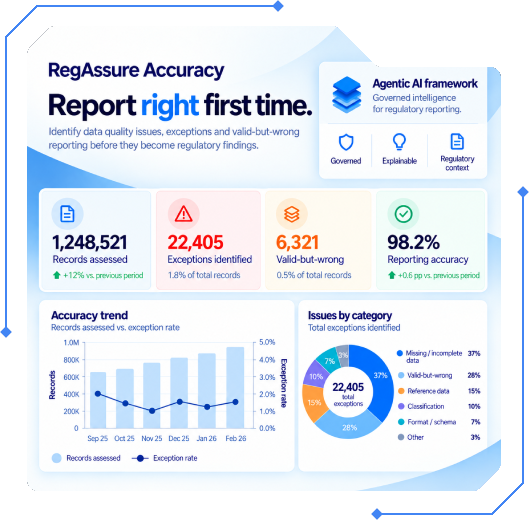

Independent Reporting Assurance
Assess submitted regulatory data independently of the systems and controls that originally produced it.
RegAssure Accuracy examines reporting outcomes to identify inaccurate values, inconsistent reporting logic, data-quality weaknesses and other issues that may remain hidden after successful submission.
This provides an additional assurance layer over existing reporting infrastructure.
Automated Data Quality Testing
Detect issues at scale
Automated testing evaluates regulatory reporting data against defined regulatory and data-quality rules.
Checks can incorporate authoritative external reference data, including FIRDS, GLEIF and ANNA, helping identify discrepancies that basic schema or mandatory-field validation may not expose.
Testing can be performed across large reporting populations without relying solely on manual sampling.

Continuous Reporting Monitoring
Move from periodic reviews to ongoing assurance
Reporting risks can emerge long after implementation as systems, mappings, reference data and regulatory requirements change.
RegAssure Accuracy supports recurring testing across daily, weekly, monthly or quarterly reporting cycles, enabling firms to identify emerging issues and monitor reporting quality over time.
Results provide reporting teams with a structured view of identified risks, errors, breaches and exceptions.
Risk & Exception Analysis
Focus teams on what needs attention
Not every reporting issue carries the same regulatory or operational impact.
RegAssure Accuracy helps surface and organise exceptions so reporting teams can investigate material issues, understand recurring patterns and prioritise remediation.
This turns accuracy testing from a point-in-time exercise into an actionable reporting assurance process.
Why Accuracy Testing Is Different
- Checks whether fields are populated
- Focuses on schema and format
- Confirms submission requirements
- Often operates within the reporting process
- Finds rejected or invalid records
- Primarily pre-submission
- Tests whether reported values are accurate
- Tests regulatory and reporting logic
- Identifies valid-but-wrong reporting
- Provides independent assurance
- Surfaces accepted records that may still be incorrect
- Tests actual reporting outcomes
Coverage Across Global Reporting Regimes
RegAssure Accuracy supports reporting assurance across major global trade and transaction reporting regimes.
01 MiFIR
Transaction and transparency reporting
02 EMIR Refit
Derivatives reporting
03 SFTR
Securities financing transactions
04 CFTC
Swap data reporting
05 SEC SBSR
Security-based swap reporting
06 MAS
Singapore derivatives reporting
07 ASIC
Australian derivatives reporting
08 HKMA / HKTR
Hong Kong derivatives reporting
09 FinFraG
Swiss derivatives reporting
10 REMIT
Energy market reporting data quality support
Case Study
Reporting quality review for a regulated brokerage firm
Example based on Reg-X client reporting assurance work. Replace with approved client name or anonymised version before publishing.
“The review helped identify accepted reports that still contained reporting quality issues, giving the team a clearer remediation path and evidence for oversight.”
Why Reg-X
01 Specialist Expertise
Regulatory reporting specialists with practical experience across reporting requirements, implementation, assurance and remediation.
02 Technology + SME Support
Automated testing is combined with regulatory expertise to help distinguish genuine reporting issues from technical noise.
03 Reporting Assurance Focus
Purpose-built around trade and transaction reporting rather than generic enterprise data-quality testing.
04 Remediation Experience
Identified issues can be traced through reporting logic, data and controls to support investigation and remediation.
05 Global Coverage
Support across MiFIR, EMIR Refit, SFTR, CFTC, SEC SBSR, MAS, ASIC, HKMA, FinFraG and other reporting regimes.
06 Technology, Advisory & Managed Services
Use RegAssure Accuracy as a technology solution, an independent assurance exercise or as part of a wider managed reporting service.
Find the reporting errors your existing controls may be missing.
Successful submission is only one measure of reporting quality.
RegAssure Accuracy provides an independent view of what has actually been reported, helping firms identify inaccuracies, investigate exceptions and strengthen regulatory reporting assurance.
10+ Global Regulatory Regimes
All Asset Classes
Unlimited Transaction Volume
24×7 Cloud SaaS
Frequently Asked Questions (FAQ)
Accuracy testing assesses whether information submitted to a regulator or trade repository accurately reflects the underlying transaction and applicable reporting requirements. It goes beyond checking whether a report is technically valid or successfully accepted.
Pre-submission validation typically checks whether required fields, formats and schemas satisfy submission requirements. Accuracy testing examines whether the values and reporting decisions themselves are correct, including records that may already have passed validation.
Yes. A report may satisfy technical validation requirements while containing incorrect values, mappings, classifications or reporting logic. These are the types of valid-but-wrong issues that independent accuracy testing is designed to identify.
Coverage includes MiFIR, EMIR Refit, SFTR, CFTC, SEC SBSR, MAS, ASIC, HKMA/HKTR and FinFraG, with additional reporting requirements supported where applicable.
No. It provides an additional independent assurance layer over existing reporting systems, validation controls and operational processes.
Yes. Testing can support recurring reporting assurance across daily, weekly, monthly or quarterly cycles depending on the firm’s reporting environment and assurance requirements.
Reg-X combines technology with regulatory reporting expertise to support investigation of identified exceptions, root-cause analysis and remediation where required.