
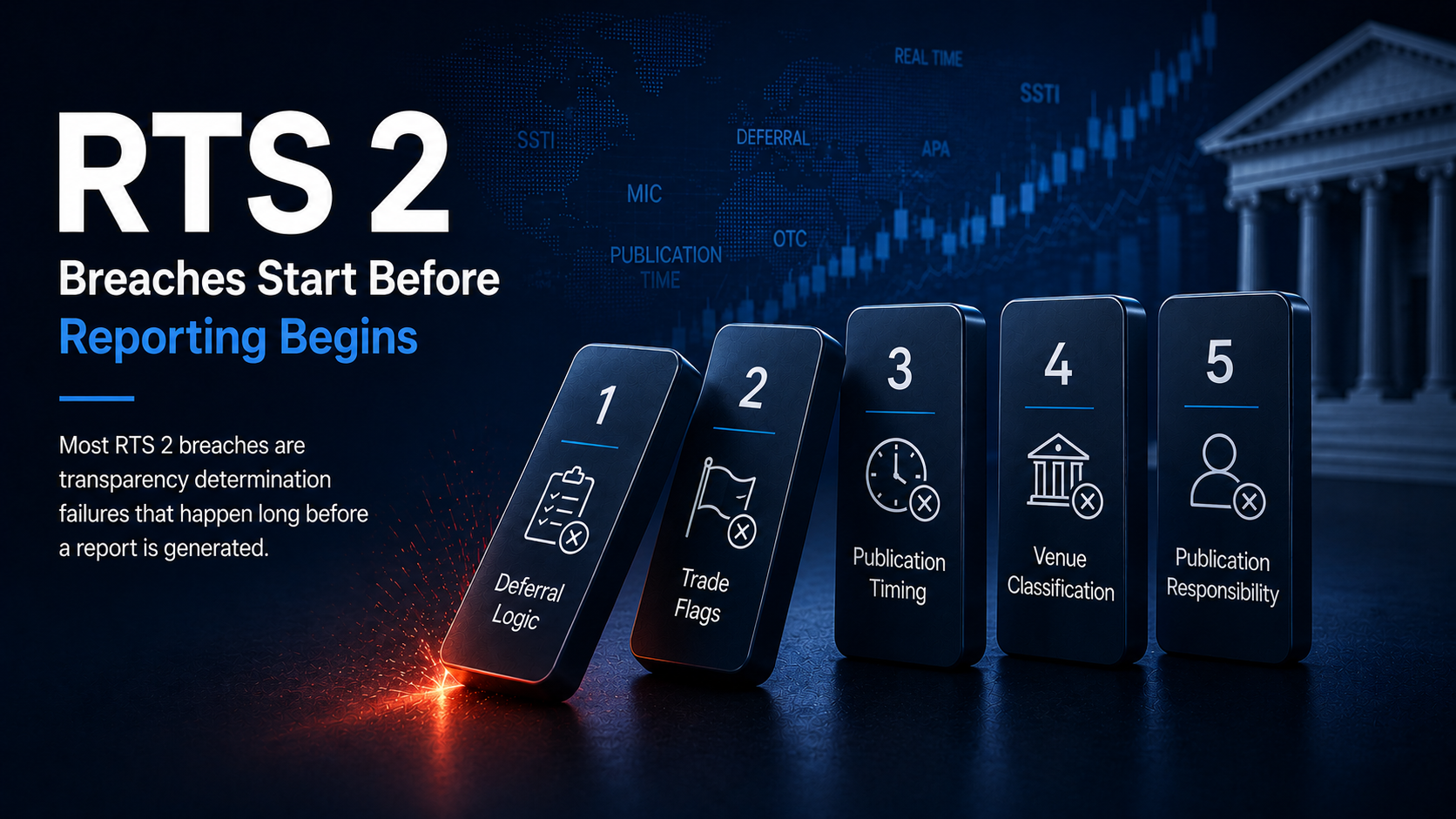
Most RTS 2 breaches are not reporting failures. They are transparency determination failures. Firms get deferrals, flags, publication timing, or publication responsibility wrong before a report is ever generated. Drawing on our experience delivering regulatory reporting accuracy through RegAssure, here are the ten most common RTS 2 issues we encounter.
1. Deferral Eligibility and Deferral Flag Errors
RTS 2 allows publication delays for certain large or illiquid transactions. Determining eligibility requires accurate assessment of liquidity, transaction size, LIS and SSTI thresholds, and applicable deferral regimes. Many firms rely on static rules or outdated reference data, leading to trades being published too early or deferred incorrectly.
Typical root causes:
- Incorrect LIS/SSTI calculations
- Outdated ESMA transparency data
- Poor reference data integration
- Manual intervention during processing
2. Incorrect Post-Trade Flags
Execution flags provide essential context around how a trade was executed, such as package, negotiated, or benchmark transactions. Incorrect flagging can distort transparency and create misleading market signals, even when the trade itself is reported correctly.
Typical root causes:
- Misinterpretation of ESMA flag definitions
- Inconsistent application across desks
- Different logic across trading systems
- Weak governance over flag assignment
3. Publication Timing Errors
RTS 2 requires transactions to be published as close to real time as possible unless a valid deferral applies. Firms often focus on data quality while overlooking publication timing, creating breaches despite otherwise accurate reports.
Typical root causes:
- Batch-based reporting processes
- Delayed APA submissions
- Incorrect deferral expiry calculations
- Manual review bottlenecks
4. OTC versus Venue Classification Errors
Whether a trade is executed OTC or on a trading venue directly impacts transparency treatment and publication responsibility. Classification errors are particularly common in fixed income and derivatives markets involving RFQs, voice trading, and hybrid execution models.
Typical root causes:
- Ambiguous execution workflows
- Incorrect MIC mappings
- RFQ classification errors
- Inconsistent booking practices
5. Price Reporting Errors
Price is one of the most important RTS 2 data points and one of the most frequently reported incorrectly. Common issues include reporting yield instead of price, clean versus dirty price confusion, and precision errors.
Typical root causes:
- Multiple pricing conventions
- Incorrect source mappings
- Currency conversion issues
- Misunderstanding APA requirements
6. Volume and Notional Reporting Errors
Different asset classes require different quantity measures, creating challenges across bonds, derivatives, and structured products. Incorrect volumes can affect transparency calculations and market interpretation.
Typical root causes:
- Product complexity
- Inconsistent quantity fields
- Contract multiplier errors
- Derivatives reporting misunderstandings
7. Instrument Classification Errors
Incorrect instrument classification can trigger downstream errors across deferrals, thresholds, transparency requirements, and reporting fields. This is particularly challenging for structured products, ETCs, ETNs, and complex derivatives.
Typical root causes:
- Weak reference data governance
- FIRDS mismatches
- Product taxonomy errors
- New product onboarding issues
8. Publication Responsibility Confusion
RTS 2 sets out specific rules regarding which party is responsible for publication. Where ownership is unclear, firms risk duplicate reporting or failing to publish altogether.
Typical root causes:
- Unclear ownership models
- Complex counterparty arrangements
- SI status misunderstandings
- Poor operational procedures
9. Duplicate Reporting
Duplicate publications inflate trading volumes and reduce confidence in market transparency data. They typically arise when multiple parties believe they hold the publication obligation.
Typical root causes:
- Multiple APAs
- Unclear reporting responsibility
- System retries
- Lifecycle events treated as new trades
10. APA Mapping and Data Enrichment Errors
Many RTS 2 failures originate from incorrect mappings between source systems and the APA rather than misunderstanding the regulation itself. These errors are often difficult to detect because reports pass validation while containing inaccurate data.
Typical root causes:
- Incorrect field mappings
- Missing data enrichment
- Legacy system constraints
- Inconsistent data models
The Common Theme
When regulators review RTS 2 programmes, they rarely find firms misunderstanding the rules. Most issues stem from weaknesses in:
- Reference data quality
- Transparency determination logic
- Trade data quality
- Operational controls
For most firms, the greatest risk is not generating the APA report. It is making the correct transparency determination before reporting begins.
RegAssure helps firms identify reporting issues before submission, validate transparency decisions, and improve the quality of source data feeding their RTS 2 reporting processes. Speak to our team to learn how we can help strengthen your reporting controls.